Fresnel or Glass Lens: Two Ways to Bend Light
Compare a Fresnel lens with a curved glass lens to understand how each redirects light and choose a form that suits your space, image and optical task.
The common mistake in choosing a Fresnel lens or glass lens is to compare only how strongly each focuses light. Their shapes can redirect light in similar ways, but differ in thickness, surface detail, stray light and image quality. Those differences help explain why a projector, magnifier and lighting optic may need different designs.
Both lens types redirect light by changing its direction
Light changes direction as it passes between materials with different refractive properties, such as air and glass. At a curved boundary, rays meet the surface at different angles, allowing a lens to bring them towards a focus, spread them apart or reshape a beam.
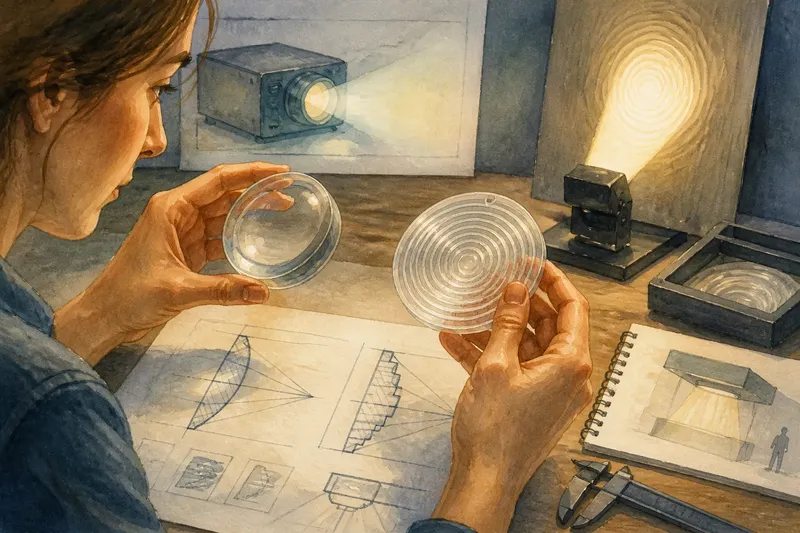
A conventional glass lens uses a continuous curved surface. A Fresnel lens uses concentric or linear grooves, each arranged to reproduce much of the direction-changing effect of a larger curved surface. The optical aim is similar; the geometry doing the work is different.
In a simple convex lens, the surface angle gradually changes from the centre towards the edge. A Fresnel lens breaks that profile into stepped zones, with facets angled to send light in a desired direction. The grooves work together to approximate the redirection produced by a broader curved lens.
A Fresnel lens reduces bulk but adds surface structure
A thick conventional lens contains material between its curved front and back surfaces. If a lens needs a long focal length across a broad aperture, that body can become bulky and heavy. A Fresnel design retains useful surface angles while omitting much of the material that would otherwise fill the lens.
This can make Fresnel lenses useful when a large optical area must fit into a shallow assembly. They appear in overhead projectors, some rear-projection systems, reading magnifiers and specialised lighting or signalling optics. Some have circular grooves; others use parallel grooves to shape light chiefly in one direction.
The trade-off is visible in the surface. A smooth curved lens presents a continuous profile, while a Fresnel lens has steps that can scatter or diffract some light, particularly at groove edges. Depending on the design, manufacture, alignment and viewing conditions, the image may show reduced clarity, faint rings or other artefacts.
Fresnel does not mean poor image quality, just as glass does not automatically mean perfect imaging. A well-designed Fresnel optic can suit a task where a broad, shallow element matters more than fine image detail. A conventional lens may be preferable when smooth focus and reduced visible artefacts matter more.
Curved glass favours continuous optical surfaces
A conventional curved lens can provide a smooth transition in surface angle across its aperture. That continuity helps manage image formation, though it does not remove every optical imperfection. Spherical aberration, chromatic aberration, reflections and manufacturing errors can still affect the result; demanding systems may use several elements to control them.
Optical glass can be selected for properties such as refractive index, dispersion and thermal behaviour. A simple Fresnel sheet may instead be made from polymer, but Fresnel optics can also use other materials. The term describes a design approach, not a single substance.
Material and shape should therefore be considered separately. A Fresnel lens can be glass or plastic, and a conventional lens can also be made from glass or a suitable polymer. The central distinction is between a stepped surface that approximates a fuller profile and a continuous surface that carries the profile directly.
Groove patterns shape the visible result
Groove spacing and facet shape influence how a Fresnel lens handles light. Coarser grooves can leave more noticeable structure in the transmitted image; finer grooves may make that structure less apparent, although the overall result depends on the design and intended use. Groove orientation matters too: linear grooves can distribute light differently across horizontal and vertical directions.
These effects are easier to accept in some applications than others. A light collector may need to redirect illumination towards a sensor or screen, where a smooth view of the source is not the main requirement. A magnifier used to inspect small print makes local distortion and surface artefacts more conspicuous.
A continuous curved lens has constraints of its own. A large, strongly curved component can be difficult to package, and a single element may not correct colour or aberration sufficiently for demanding imaging. Designers may combine elements or choose an aspheric profile, adding complexity in exchange for greater optical control.
Say a display designer has a shallow space for an optical sheet that must redirect light towards a viewing area, while the source itself need not appear with photographic clarity. A Fresnel element could fit the space; the expected result would be a changed light distribution, with possible groove structure visible on close inspection. If the same design must preserve fine image detail, a smoother curved lens or another optical arrangement may be a better candidate.
Fresnel lens or glass lens: what changes in practice?
A Fresnel lens is often thinner than a conventional curved lens designed for a similar optical role and aperture because its stepped profile removes much of the material that would fill the curved body. That comparison is not automatic: the finished component still has thickness, and the actual difference depends on the optical design and mounting. A curved lens may be shallow in one application, while a Fresnel lens may need a protective frame or support that changes the space it occupies.
The more useful comparison is the job each lens must perform. A Fresnel design can offer a broad, shallow optical surface, but its grooves may scatter light or make structure visible. A conventional curved lens offers a continuous surface that is often a better starting point for clear viewing, though its bulk, aberrations and material choices still matter.
For example, imagine a designer has a shallow housing and needs to redirect light from a lamp towards a broad screen, without preserving a detailed image of the lamp. The designer compares a grooved Fresnel sheet with a curved lens that would occupy more of the housing. If the Fresnel sheet spreads the light as required and its visible grooves do not interfere with viewing, its compact profile is a sensible trade-off; if groove artefacts remain distracting, the curved lens or a revised optical layout becomes the better option.
Which lens suits your optical task?
Is a Fresnel lens always thinner than a glass lens?
No. Its stepped profile is intended to reduce material compared with a conventional lens of similar optical role and aperture, but the finished thickness depends on design and mounting. Compare the complete components, not just the lens surfaces.
Does a Fresnel lens create a real focus?
It can direct rays towards a focus, much like a conventional converging lens. The focus and image quality depend on the optical prescription, the light source and alignment, rather than the lens label alone.
Why can a Fresnel lens look ridged or produce rings?
The ridges are zones that approximate a continuous curved profile. Their edges can scatter or diffract light, making the groove pattern or related artefacts visible in some designs.
Which lens is better for a clear image?
A smooth conventional lens is often a suitable starting point when the priority is viewing fine detail through the optic. A Fresnel lens can also be used for imaging, but its groove effects and design limits need to suit the application.
Choose by the optical job, not the lens label
Start by deciding what the lens must do: form a detailed image, collect light, spread illumination or redirect a beam. Then consider the aperture, available depth, acceptable surface artefacts, material, colour behaviour and mounting. These criteria show whether a compact stepped profile or a continuous curved surface is the more sensible starting point.
- Check whether the lens must preserve fine print or other small details; if it must, favour a smooth curved surface or another imaging design, and otherwise consider a Fresnel lens.
- Check whether the available space is shallow; if it is, compare a Fresnel lens with the full mounted depth of a curved lens, and otherwise let image quality and optical behaviour lead the choice.
- Check whether grooves or rings would be visible in the viewing path; if they would distract, choose a smoother surface or change the optical layout, and otherwise assess whether the Fresnel form meets the light-shaping need.
- Check whether the task is chiefly to redirect or collect light rather than form a detailed image; if so, consider a Fresnel lens, and if not, compare imaging performance before choosing.
- Check the required material and operating environment against the product specification; if the material is unsuitable or unspecified, ask the manufacturer or an optical professional, and otherwise proceed to compare the lens geometry.
- Check whether the mounted component can be aligned and supported as intended; if not, choose a compatible mount or another lens arrangement, and otherwise evaluate the optical trade-offs in the assembled device.
For components in devices, the product specification and manufacturer’s instructions determine compatibility and handling. For precise imaging or safety-critical illumination, consult a qualified optical professional. In an ordinary comparison, look through each lens at a straight edge and a small-print page, then move it slowly: distortion, groove visibility and focus behaviour become easier to distinguish.
A Fresnel lens is not merely a thinner glass lens; it distributes the optical work across a different surface geometry. The main search phrase, Fresnel lens or glass lens, is therefore best answered by asking what the light must do after passing through the component and how much visible surface structure the application can accept.